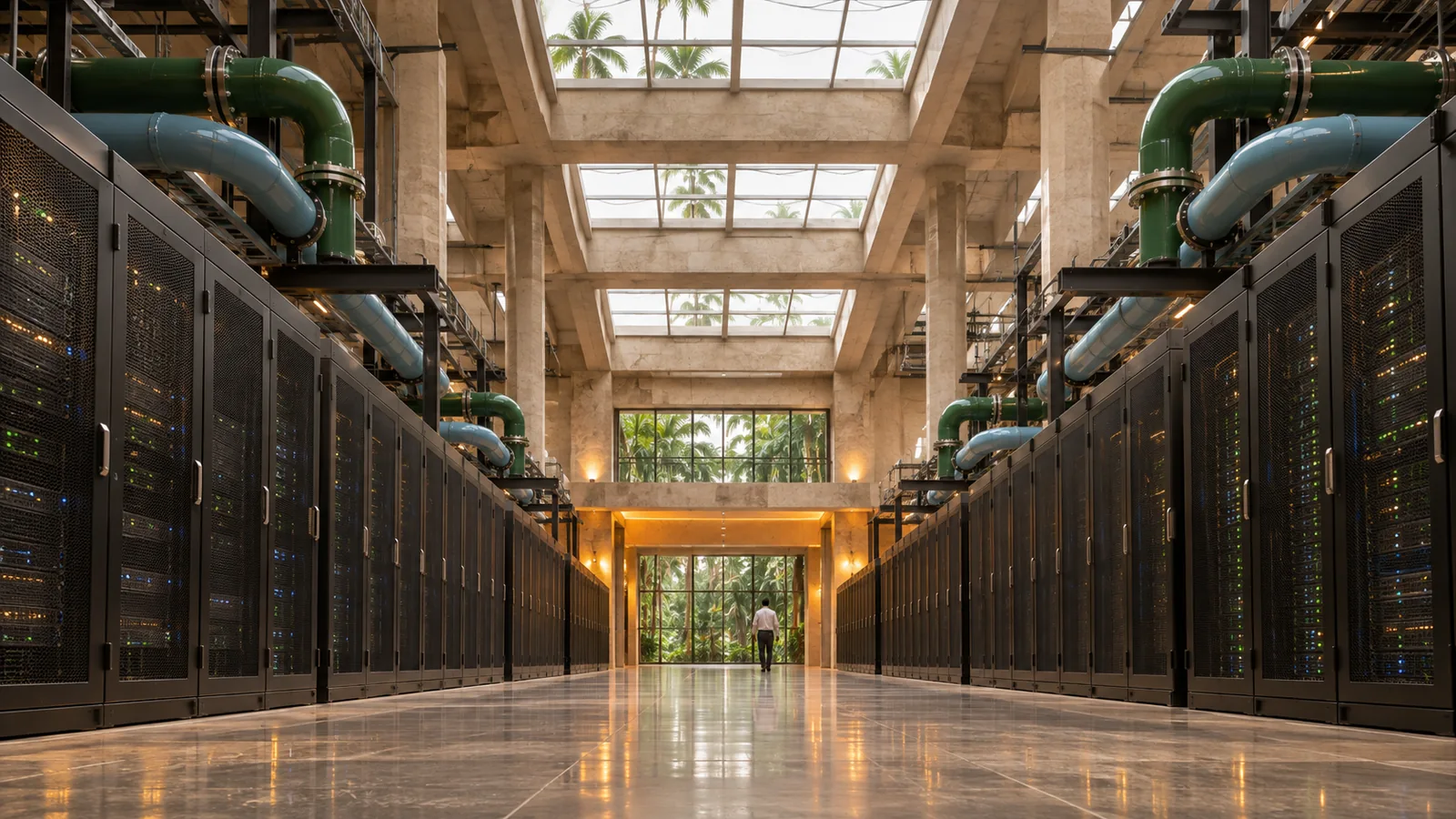
Larsen & Toubro has secured another order for NVIDIA B300 GPUs at its Chennai data centre. An inference infrastructure provider has made a multi-year commitment to use equipment deployed by LTN Compute, a subsidiary of L&T group company Vyoma.AI. L&T announced the order on 23 November. It will support a platform for training, fine-tuning and serving specialised AI models.
Two numbers put the announcement in perspective. L&T classifies this order as “large”, its band for contracts worth ₹2,500 crore to ₹5,000 crore. Separately, it describes the deployment as part of a 10,000-GPU cluster. The company has disclosed neither the exact contract price nor the number of additional GPUs in this order. Dividing the top of the price band by 10,000 would therefore give a buyer a meaningless price per GPU.
What changed since August
On 13 August, L&T announced a Chennai partnership with Together AI and described an installation designed for 10,000 B300 GPUs. The August release named Together AI and carried comments from both companies. The November release describes its counterparty only as an inference infrastructure provider. The site, GPU model and cluster plan connect the announcements. The identity of the November customer remains undisclosed.
The new information is a further multi-year commitment against that infrastructure. Neither announcement gives a commissioning date for the additional machines, a breakdown between reserved and unallocated capacity, or terms for third-party access. For an Indian cloud reseller, the news is evidence of a supplier building a substantial inference business in Chennai. It is too early to put a delivery date or an hourly B300 rate on a customer proposal from these disclosures alone.
Why a 250 MW campus is only part of the story
L&T specifies a 250 MW design for the campus’s first phase. That figure describes the scale of the planned facility. It tells a customer little about how much compute a particular model will receive at peak time. The company also lists high-speed links between machines and parallel storage alongside the GPUs. Those details matter to a buyer that needs to load a large model, feed it data and serve many requests at once.
Consider two prospective customers. One wants to process a queue of documents overnight and can spread the work across several hours. The other is putting a voice assistant in front of paying users. A configuration that finishes the overnight batch economically could still make a caller wait too long for the first words of a reply. The same GPU model appears on both proposals, but the acceptance tests should look different.
What an MSP should ask before quoting
Start with the workload the customer will run. For the interactive service, ask for time to first token, the gap between subsequent tokens and performance when the expected number of users arrive together. NVIDIA’s AIPerf documentation treats these as distinct measurements. For the batch customer, a more revealing demonstration is how many representative documents finish inside the overnight window and what that run costs. In both cases, record the model, input length and output length so that two offers can be compared on the same basis.
Then ask the supplier to confirm the start date for the reservation, specify the network and storage included in the rate, and put the remedy for unavailable capacity in writing. Those details determine what an MSP can promise its customer. The next meaningful milestone for the Chennai project will be delivery or a bookable service with published commercial terms. A cloud provider bidding for a customer’s business this quarter needs that allocation date before it can commit to one of its own.
Updated 27 November 2026 with L&T’s order-value band, the earlier Together AI agreement and the distinction between announced and bookable capacity.
Sources
Larsen & Toubro, Chennai GPU order and contract-value classification · 2026-11-23
Larsen & Toubro, Together AI partnership and planned cluster, 13 August 2026
Data Center Dynamics, coverage of the Chennai deployment, 24 November 2026
NVIDIA AIPerf, reference for measuring inference performance